


I’m having a bit of a FUEL renaissance lately. Whenever I have a mix question without a clear answer, whenever I want to try something new, FUEL has been my go-to plugin. The reason is, simply put, FUEL can do a whole lot. Not only are there plenty of controls to tweak, but I keep discovering new interactions between those parameters. crunch, for instance, is a different beast with the compressor section set to OTT. It’s easy to use FUEL tastefully if that’s what you want - and don’t get me wrong, it’s great for gentle compression or saturation - but it really starts to get interesting when it’s pushed. More and more, I’m finding myself using settings on FUEL that at first sound excessive or even ugly, but with proper dialing end up giving my mixes just what they need.
The key to unlocking these kinds of settings is usually OTT. Switching FUEL’s compressor to OTT takes it from bread-and-butter compression to an over-the-top (OTT, get it?) multiband that goes from zero to WTF very quickly. It introduces distortion, grit, aggressive high end and midrange, and all sorts of other qualities we tend to classify as “artifacts” when describing heavy-handed compression. At first, I thought I didn’t like OTT for that exact reason - it’s just too much! The effect is multiplied when you start raising the other controls, like the aforementioned OTT/crunch combo, and somehow “too much” becomes even too much-er.
There’s a centuries-old idea from the world of toxicology that the difference between medicine and poison is in the dosage, and this concept applies here. FUEL - especially with OTT on - is nasty. Let it be. Don’t try to tame the nastiness. Just use it at the appropriate dosage.
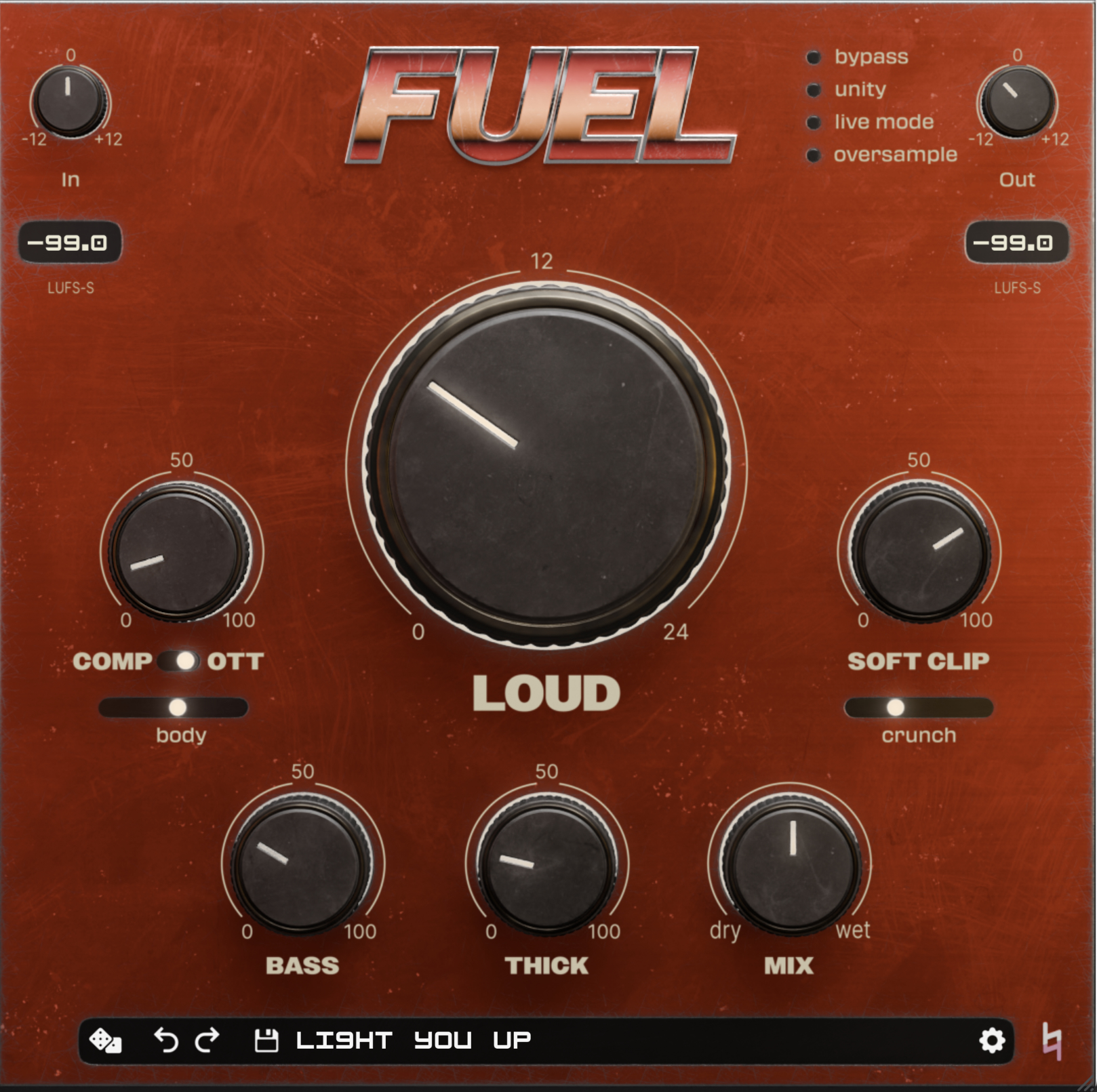
What does that mean, in practical terms? It means that FUEL’s gnarlier tones are best delivered in parallel. My favorite uses of FUEL these days tend to be ones where the plugin is crankin’ but the mix knob or return aux is dialed low. Yeah, OTT and SOFT CLIP dialed at 10 o’clock, plus crunch or body, is probably going to sound intense and trashy on its own. Mixed with dry signal - vocals, drums, synths, whatever - it starts to add presence and density. Suddenly, whatever it is that FUEL is adding parallel pandemonium to has jumped to the front of the mix, is edgy and exciting, and is dripping with sparkle. Somehow, at the right dosage, “trashy” becomes polished. Go figure.
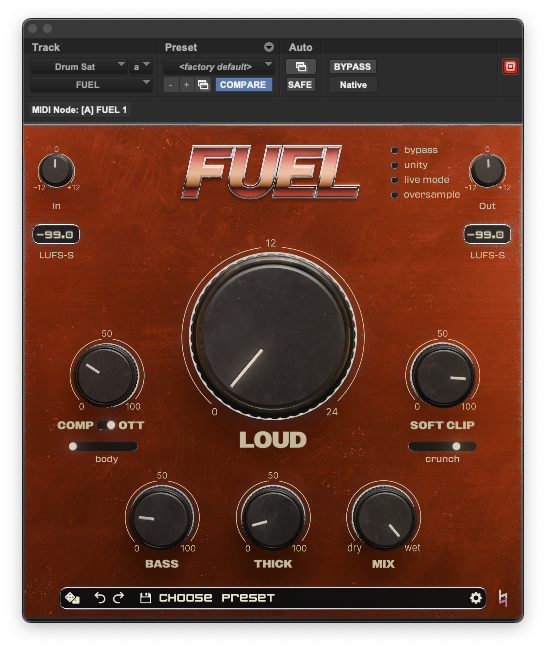
This idea merits some follow-up articles with more specific use cases - a couple recent favorites of mine include parallel saturation buses for vocals and drums. The settings in the screenshot above are from a drum saturation bus, which is dialed down -30 dB on the return aux. Stay tuned! For now, though, take this bit of inspiration for your own uses of FUEL: “way too much” is actually the sweet spot. Dial FUEL past the point of good taste, bring it way down in the mix, and listen to the way it transforms your track.